

LiftMaster vs. Chamberlain vs. Genie: Choosing a Garage Door Opener
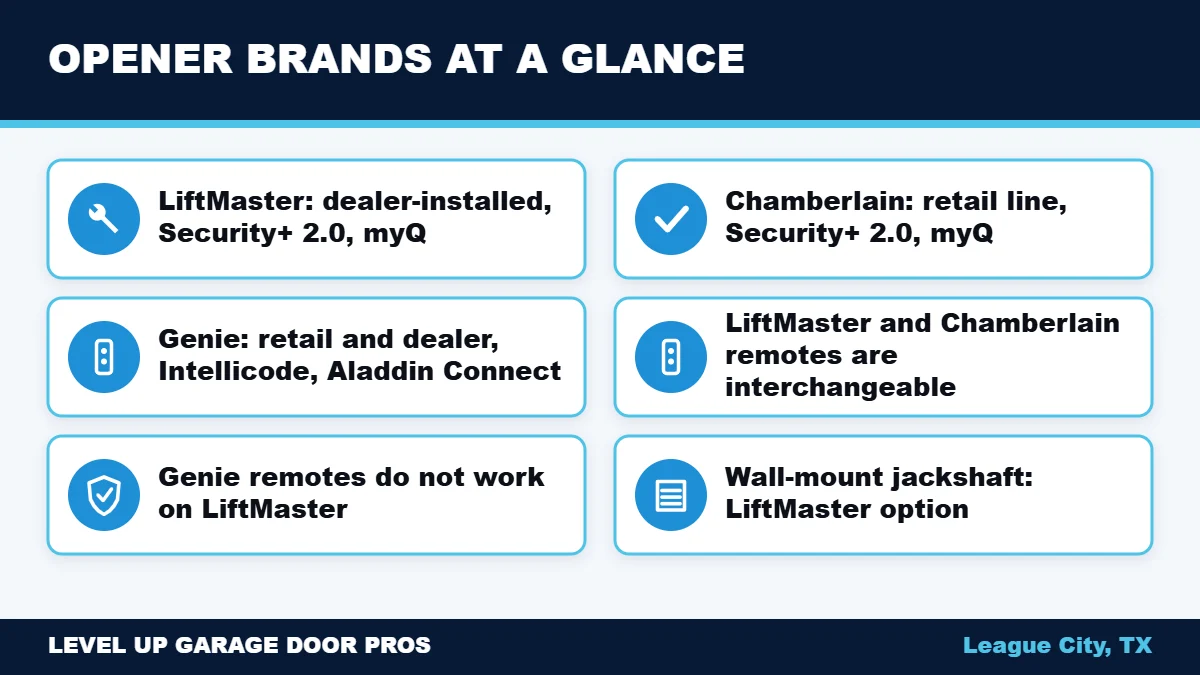
LiftMaster and Chamberlain are made by the same company, Chamberlain Group, and share the same core technology, including Security+ 2.0 remotes and the myQ app. The real difference is how they are sold: LiftMaster goes through professional dealers and installers, while Chamberlain is the retail line you find at big-box stores. Genie is a separate brand made by Overhead Door Corporation, uses its own Intellicode remotes and the Aladdin Connect app, and is known for offering screw-drive models. For most garages, the right choice comes down to drive type, noise, remote compatibility, and who will install and support the opener, more than the logo on the motor.
When an opener dies, most people want a quick answer to “which brand should I get?” We install and service all three, and we hear the same questions every week. This guide lays out what is actually different, what is mostly marketing, and how to pick the right unit for your door.
Are LiftMaster and Chamberlain the Same?
Mostly, yes. Chamberlain Group is the parent of LiftMaster, Chamberlain, Merlin, and Grifco, and it develops the myQ platform used by both main brands. LiftMaster and Chamberlain openers use the same Security+ 2.0 rolling-code system, so their remotes and keypads are generally interchangeable.
The split is about the sales channel. LiftMaster is sold through professional dealers and contractors and includes models built for installers, such as wall-mount jackshaft openers and a commercial operator line. Chamberlain is sold through retailers and is designed for buyers who plan to install the opener themselves. That affects packaging, model numbering, and how warranty claims are handled. A dealer-installed LiftMaster is usually serviced through the company that installed it, while a retail Chamberlain warranty goes through the manufacturer directly.
How Is Genie Different?
Genie is an independent brand made by Overhead Door Corporation, a long-time name in the garage door industry. Genie openers are sold both through retailers and through dealers. A few practical differences stand out:
- Remotes: Genie uses its own Intellicode rolling-code system. Genie remotes do not program to LiftMaster or Chamberlain openers, and the reverse is also true.
- App: Genie’s smart models use the Aladdin Connect app instead of myQ.
- Drive types: Genie is one of the few brands still offering screw-drive openers, alongside chain and belt models.
If you already have several Genie remotes and a keypad that work well, staying with Genie can save you from replacing all of them. The same logic applies if your vehicles have built-in buttons already programmed to a LiftMaster or Chamberlain system.
How Do the Three Brands Compare?
| Feature | LiftMaster | Chamberlain | Genie |
|---|---|---|---|
| Maker | Chamberlain Group | Chamberlain Group | Overhead Door Corporation |
| Sold through | Professional dealers | Retail stores and online | Retail and dealers |
| Rolling code | Security+ 2.0 | Security+ 2.0 | Intellicode |
| Smart app | myQ | myQ | Aladdin Connect |
| Drive types | Chain, belt, wall-mount jackshaft | Chain, belt | Chain, belt, screw |
| Warranty support | Usually through the installing dealer | Through the manufacturer | Depends on where it was purchased |
Model lineups change every year, so treat this as a general guide and check the specific model’s spec sheet before buying.
Which Drive Type Should You Choose?
In our experience, drive type affects day-to-day satisfaction more than brand does.
- Chain drive: Durable and budget-friendly, but the loudest. A good fit for a detached garage or a garage with no living space above it.
- Belt drive: Much quieter thanks to a reinforced rubber belt. The most popular choice when there is a bedroom over or next to the garage.
- Screw drive: Fewer moving parts and a strong lift. Offered mainly by Genie.
- Wall-mount jackshaft: Mounts beside the door on the torsion bar, which frees up ceiling space. Useful for garages with high ceilings, storage racks, or limited headroom. These require a torsion spring system.
Our guides to chain drive vs. screw drive openers and the main types of garage door openers cover each option in more detail.
What About Smart Features and Apps?
All three brands offer models with built-in Wi-Fi, so you can open, close, and check the door from your phone. LiftMaster and Chamberlain use myQ, and Genie uses Aladdin Connect. Both apps send alerts when the door opens and can let you grant access to family members or delivery services.
One thing to know before you buy: third-party compatibility has changed over time. Chamberlain Group restricted outside access to the myQ platform in late 2023, which affected some open-source and third-party integrations. If you plan to control the door through a specific voice assistant or automation system, confirm current compatibility for that exact model instead of relying on an older review.
Do You Need Battery Backup?
On the Gulf Coast, battery backup is worth considering. Storms and outages are common in League City, and a battery backup lets you open and close the door for a limited number of cycles when the power is out. Without it, you would need to use the manual release and lift the door by hand. Many mid-range and upper-tier models from all three brands offer battery backup either built in or as an add-on, so ask about it when comparing quotes.
How Much Horsepower Do You Need?
A properly balanced door does not need a huge motor, because the springs carry most of the weight. Most single-car and standard double-car doors work well with a typical 1/2 HP or 3/4 HP equivalent opener. Heavier doors, such as solid wood, oversized, or heavily insulated doors, benefit from more lifting power. If an opener is struggling, the cause is often worn springs rather than a weak motor, and putting a stronger opener on an unbalanced door only hides the problem.
What Should You Check Before Replacing an Opener?
A surprising number of opener replacements are not needed. Before you buy any brand, rule out these common causes, because each one can make a healthy opener look broken:
- Safety sensors: Misaligned or dirty photo-eyes stop the door from closing and make the opener light flash.
- Broken spring: If a spring has snapped, the opener may hum, strain, or lift the door a few inches and stop.
- Lock mode: Many wall controls have a lock or vacation button that disables remotes.
- Remote battery or programming: A weak battery or a remote that lost its code can feel like a dead opener.
- Track or roller problems: A binding door makes the opener reverse as if it hit something.
If the motor is over 10 to 15 years old, has stripped gears more than once, or lacks working safety sensors, replacement is usually the better path. Otherwise, a repair may give you several more years.
What Mistakes Should You Avoid When Buying a New Opener?
- Buying the wrong rail length: Standard rails fit 7-foot doors. An 8-foot door needs an extension kit or a longer rail.
- Ignoring headroom: Low ceilings may not have room for a trolley-style opener, which is where a wall-mount unit helps.
- Skipping the balance check: A new opener on a door with worn springs will wear out early.
- Forgetting accessories: Count how many remotes, keypads, and vehicle buttons you need, and confirm they match the new system.
- Mixing up brands: Switching from Genie to LiftMaster, or the other way around, usually means replacing every remote and keypad.
Which Brand Is Best for Your Garage?
- You want professional installation and dealer support: LiftMaster is a strong choice, especially if you want a wall-mount opener.
- You plan to install it yourself: Chamberlain gives you similar technology at retail.
- You already use Genie remotes and keypads, or want a screw drive: Genie keeps your accessories working.
- Noise matters most: Choose a belt drive or wall-mount model from any brand.
- Outages are a concern: Pick a model with battery backup.
Budget also plays a role. Our article on garage door opener installation cost explains what affects the final price, including the opener, rail length, accessories, and labor.
Opener Installation and Repair in League City
Level Up Garage Door Pros installs and repairs LiftMaster, Chamberlain, and Genie openers for residential and commercial doors. Before recommending a new unit, we check the door’s balance and springs so the opener is not doing work the springs should handle. If you already own one of these brands, we also offer dedicated LiftMaster garage door service and Chamberlain opener service. For troubleshooting, replacement, or a new install, see our garage door opener repair and installation page. We serve League City, Webster, and surrounding communities.
Frequently Asked Questions
Is LiftMaster better than Chamberlain?
LiftMaster and Chamberlain are made by the same company and share the same core technology. LiftMaster is the professional dealer line and offers some installer-focused models, while Chamberlain is sold at retail for do-it-yourself installation.
Can I use a Chamberlain remote on a LiftMaster opener?
In most cases, yes. Both brands use the Security+ 2.0 rolling-code system, so compatible remotes and keypads can be programmed across the two brands. Check the remote’s compatibility list for older openers.
Will a Genie remote work with a LiftMaster opener?
No. Genie uses Intellicode technology, which is not compatible with the Security+ 2.0 system used by LiftMaster and Chamberlain. Universal remotes are an option if you need one remote for both.
What is the quietest garage door opener?
Belt drive and wall-mount jackshaft openers are generally the quietest options. Chain drive openers tend to be the loudest.
How long do garage door openers last?
Many openers last around 10 to 15 years, depending on usage, maintenance, and whether the door is properly balanced.