

Residential Gate Repair vs. Replacement: How to Decide
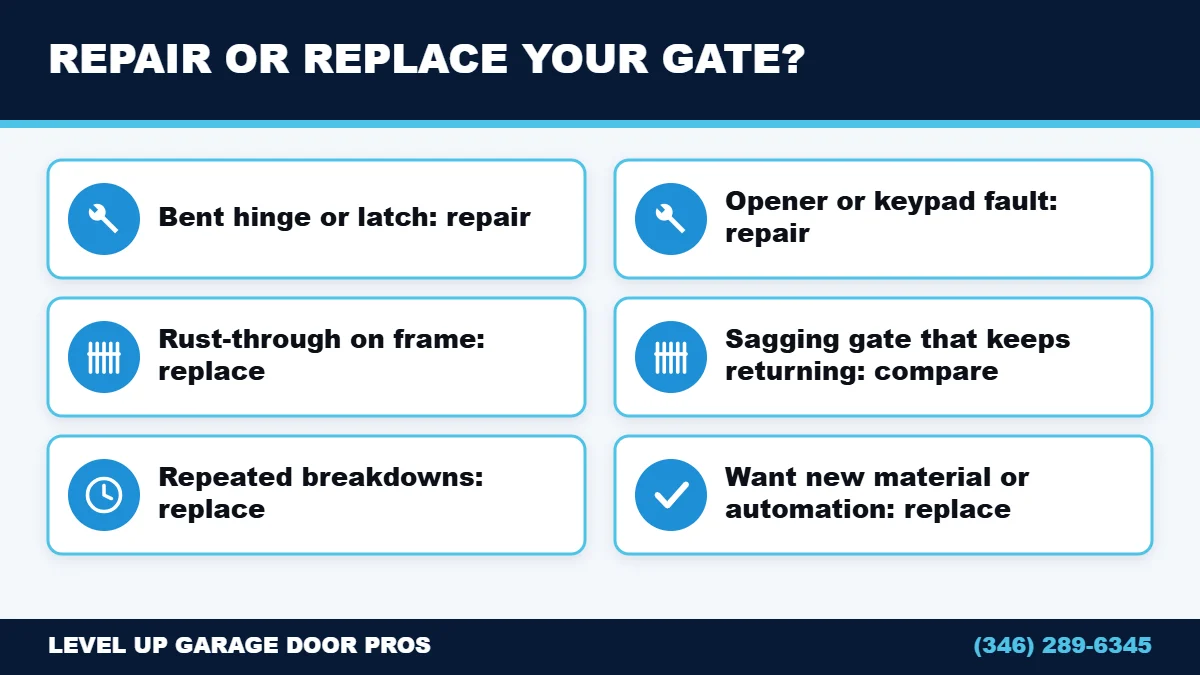
Repair a residential gate when the frame and posts are still solid and the problem is limited to hinges, rollers, latches, the gate operator, a keypad, a remote, or a safety sensor. Replace it when the frame is rusted through or badly bent, the posts have shifted, the gate keeps sagging after repairs, breakdowns are frequent, or you want a different material, a different opening style, or a new automation system. Most decisions come down to one question: is the structure sound enough that the next repair will last?
Driveway gates work harder than most people realize. A swing or slide gate on a busy residential property may cycle several times a day, in heat, heavy rain, and wind, and near the Gulf Coast, in salty air that is hard on steel. When a gate stops working, many problems are straightforward fixes. Others are signs that the gate is near the end of its useful life. Here is how our gate repair technicians sort one from the other.
What Parts of a Gate System Usually Fail?
An automatic gate is really several systems working together. Knowing which one has failed is the first step:
- The gate structure: Frame, pickets, welds, and the posts it hangs on.
- Moving hardware: Hinges on swing gates, or wheels, rollers, and guide track on slide gates.
- The operator: The motor, gearbox, arm or chain, and control board.
- Access controls: Remotes, keypads, intercoms, card readers, and phone-based entry.
- Safety devices: Photo-eyes, edge sensors, and loop detectors that stop or reverse the gate.
A problem in the operator, access controls, or safety devices rarely means the gate itself needs replacing. Structural damage is where the decision gets harder.
When Is Gate Repair the Right Choice?
- Worn hinges, rollers, or wheels: These are wear parts and can be replaced individually.
- Latch or lock problems: Adjustments or new hardware usually solve them.
- Operator faults: Motors, gearboxes, capacitors, limit switches, and control boards can often be repaired or replaced without touching the gate.
- Keypads, remotes, and intercoms: Programming, wiring, and replacement units are routine fixes.
- Sensor problems: Misaligned or damaged photo-eyes stop many gates from closing and are simple to correct.
- Minor damage: A small bend in a picket or a single damaged section can often be straightened or welded.
If your gate stopped responding after a storm or power outage, start with our guides on automatic gate troubleshooting and how to reset an automatic gate.
When Should You Replace the Gate Instead?
- Structural rust: Surface rust can be treated. Rust that has eaten through the frame or welds weakens the whole gate.
- A bent frame: After a vehicle impact, a frame may never hang or latch square again.
- Shifting posts: If a post has leaned or loosened in the ground, the gate will keep sagging until the post is reset or replaced.
- Constant sagging: If the gate drags after repeated adjustments, the structure is likely failing.
- Frequent breakdowns: Several service calls in a year often cost more than a planned replacement.
- Wood rot: Rotted rails or posts on a wood gate rarely hold new hardware well.
- Upgrades: Changing from swing to slide, switching materials, or adding automation to a gate that was never built for it usually means a new gate.
How Do Gate Repair and Replacement Compare?
| Factor | Gate repair | Gate replacement |
|---|---|---|
| Upfront cost | Lower | Higher |
| Best for | Hardware, operator, access control, and sensor issues | Structural damage, rot, rust-through, or upgrades |
| Time | Often one visit | Design, fabrication, and installation |
| Lifespan added | Depends on the frame and posts | A full new service life |
| Change material or style | No | Yes |
| Safety upgrades | Possible on many operators | Built in from the start |
Material plays a big role in how long a gate lasts here. Aluminum resists rust, steel and wrought iron are strong but need coating maintenance near the coast, and wood needs regular sealing. Our guide to the best gate material compares them in detail.
One more factor to weigh is the operator. Gate operators are often replaced on their own schedule, separate from the gate. If the gate itself is sound but the operator is old, noisy, or no longer supported with parts, replacing only the operator can give you modern safety features and reliable operation without the cost of a new gate. The reverse also happens: a newer operator can sometimes be reused on a replacement gate if it is rated for the new gate’s weight and length.
What Safety Standards Apply to Automatic Gates?
Automatic gates are heavy and move with real force, so they are covered by specific standards. UL 325 sets safety requirements for gate operators, including entrapment protection such as photo-eyes and edge sensors. ASTM F2200 covers how automated vehicular gates themselves are built, for example limiting openings that could trap a hand or a child. Older gates and operators may predate current requirements.
This matters for the repair-or-replace decision. If an older operator cannot support modern safety devices, or the gate’s design creates pinch points that cannot be corrected, replacement may be the responsible option even if the gate still moves.
How Does the Gulf Coast Climate Affect Gates?
Humidity and salt air speed up corrosion on steel gates, hinges, and operator housings. Heavy rain can flood in-ground loop detectors and low-mounted electronics, and lightning-related power surges are a common cause of failed control boards. Strong winds also put stress on large swing gates and their hinges. Regular cleaning, touch-up coating, surge protection, and keeping electronics sealed all help a gate last longer in League City.
What Happens During a Gate Service Visit?
A thorough gate inspection looks at the whole system, not only the part that stopped working. On a typical visit, a technician will:
- Ask what changed: a storm, a power outage, an impact, or a gradual slowdown.
- Check power, breakers, and surge damage at the operator and control box.
- Disconnect the operator and move the gate by hand to feel for binding, dragging, or sagging.
- Inspect hinges or rollers, the guide track, posts, and welds for wear, rust, and movement.
- Test remotes, keypads, intercoms, and any loop detectors.
- Test every safety device, including photo-eyes and edge sensors, and confirm the gate stops and reverses as designed.
- Explain the findings and give written prices for repair, and for replacement if it is a close call.
If the gate is stuck open or closed, the technician should also show you how to operate it manually until the repair is finished.
How Can You Make a Gate Last Longer?
- Keep the gate path and slide track clear of gravel, leaves, and debris.
- Lubricate hinges, rollers, and chain drives on the schedule the operator manufacturer recommends.
- Rinse metal gates after storms to remove salt and grime, and touch up chipped coatings before rust spreads.
- Check that posts are still plumb and the gate latches without force.
- Protect the operator with a surge protector and make sure the control box stays sealed against rain.
- Test the safety sensors every month by placing an object in the gate’s path while it closes.
Small, regular attention costs far less than an emergency repair, and it gives you early warning when a part is starting to wear, whether the gate guards a single residential driveway or a busy commercial entrance.
What Should You Ask a Gate Repair Company?
- Is the frame and post structure still sound?
- Is the problem in the gate, the operator, or the access controls?
- Are replacement parts still available for my operator model?
- Do the current safety devices meet today’s standards?
- What warranty comes with the repair?
- If you recommend replacement, why is repair not a good option?
If replacement looks likely, our breakdown of automatic gate costs explains what affects the price of a new system.
Gate Repair in League City and Nearby Areas
At Level Up Garage Door Pros, we inspect the full gate system before recommending repair or replacement, including the structure, hardware, operator, access controls, and safety devices. We work on swing and slide gates for residential and commercial properties, and we explain the options in writing before any work begins. For local details, see our gate repair in League City page. We also serve Pearland and surrounding communities.
Frequently Asked Questions
How do I know if my gate needs repair or replacement?
If the frame and posts are solid and the problem is limited to hinges, rollers, the operator, or access controls, repair is usually reasonable. If the frame is rusted through, badly bent, or keeps sagging after repairs, replacement is often the better option.
Can a sagging gate be fixed?
Often, yes. Sagging can come from worn hinges, a loose post, or a frame that needs bracing. If the post or frame itself is failing, replacement may be needed.
Why did my automatic gate stop working after a storm?
Power surges, water in the control box or loop detectors, and tripped breakers are common causes. A technician can test the operator and electronics.
What safety standards apply to automatic gates?
UL 325 covers gate operator safety, including entrapment protection, and ASTM F2200 covers the construction of automated vehicular gates.
Which gate material lasts longest near the coast?
Aluminum resists rust well. Steel and wrought iron are strong but need regular coating maintenance in salty, humid air, and wood needs sealing to prevent rot.