
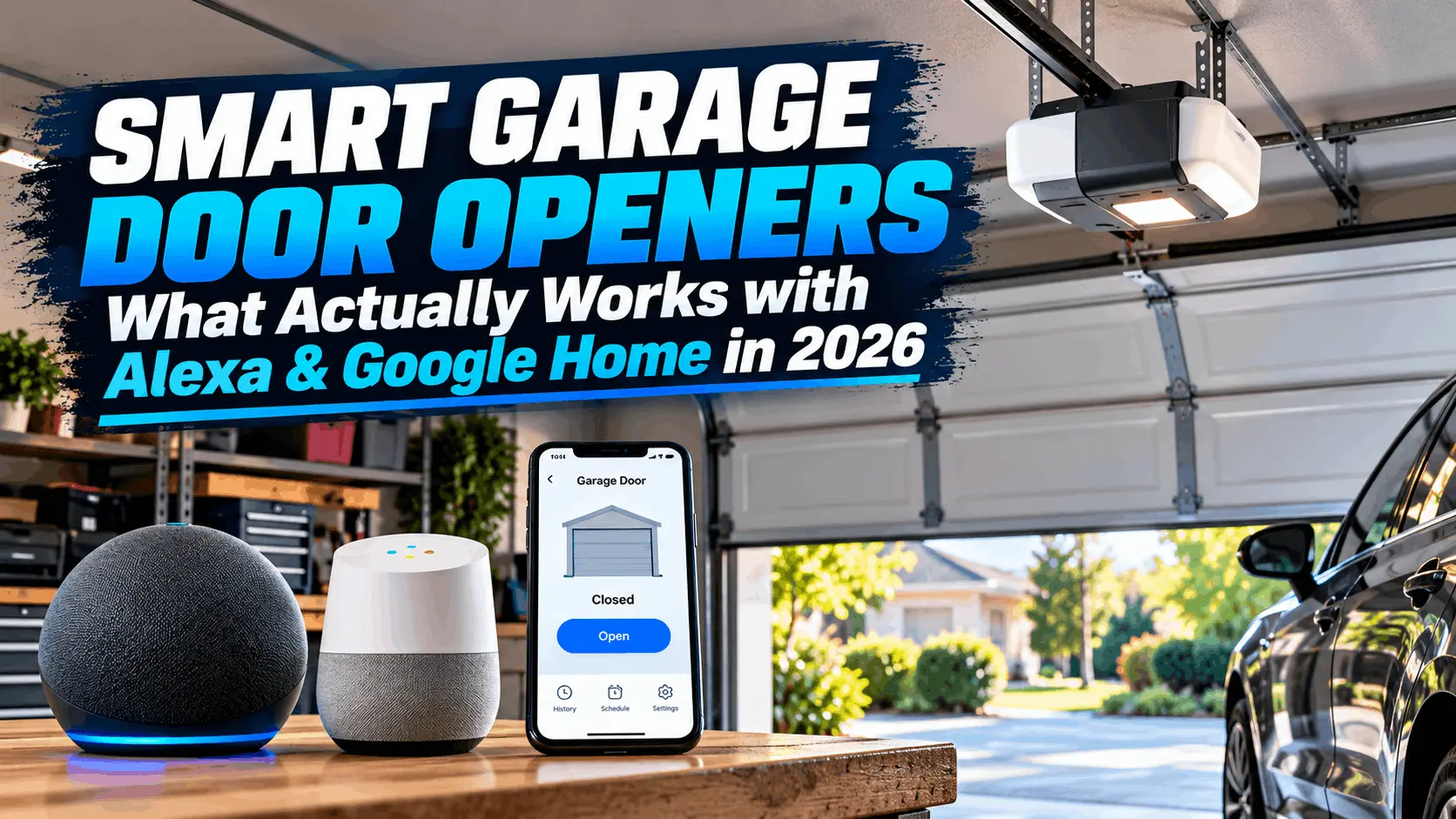

Smart Garage Door Openers: What Actually Works with Alexa and Google Home in 2026
A smart garage door opener can make everyday access more convenient by letting you check your garage door status, receive alerts, and control compatible equipment from your phone or smart speaker. However, not every smart garage door opener works with every smart home platform. If you’re researching a smart garage door opener in 2026, it’s important to understand which systems support Amazon Alexa, Google Home, and voice commands before choosing an upgrade.
Some openers have built-in Wi-Fi, while others use a separate smart controller connected to an existing garage door opener. The right option depends on your current equipment, preferred smart home ecosystem, security requirements, and the features you actually need.
What Is a Smart Garage Door Opener?
A smart garage door opener connects your garage door system to a compatible app or smart home platform. Depending on the model, you may be able to open or close the door remotely, check whether it is open or closed, receive notifications, and review activity through your smartphone.
Some systems include smart connectivity directly in the opener, while others use an additional controller and a door-position sensor. Both approaches can provide remote access, but compatibility varies by manufacturer and model.
For example, a compatible smart controller may allow you to upgrade an existing opener without replacing the entire motor unit. Before purchasing one, confirm that it works with your specific opener and that your Wi-Fi signal reaches the garage.
Does Alexa Work with Smart Garage Door Openers in 2026?
Yes, Amazon Alexa can control compatible smart garage door systems, but support depends on the product and its integration. You should not assume that an opener advertised as Wi-Fi-enabled automatically supports Alexa voice commands.
Compatible devices may allow you to open or close the garage door using a supported Alexa command. Some systems also provide status information, routines, or other smart home functions, depending on their capabilities.
A third-party controller such as a compatible Meross model may offer Alexa integration with certain existing openers. However, compatibility and setup requirements should be checked before buying.
What About Chamberlain and LiftMaster Openers?
Chamberlain and LiftMaster offer myQ-connected garage door products, but myQ connectivity does not automatically mean direct Alexa support. The availability of official integrations can change, so check the current compatibility information for your exact product before purchasing it for voice control.
If Alexa integration is essential, choose a system that explicitly lists support for your desired commands. Also check whether a PIN, additional accessory, subscription, or separate account is required.
Does Google Home Work with Smart Garage Door Openers?
Google Home can work with compatible smart garage door products, but the connection method matters. Some devices connect through a manufacturer’s linked service, while supported Matter-enabled products can connect through the Matter smart home standard.
Matter is designed to improve interoperability between compatible smart home devices and platforms. However, the Matter logo alone does not guarantee that every feature works in every app. Confirm that the specific garage door opener supports Google Home and the functions you want to use.
For example, Meross provides instructions for linking compatible garage door products to Google Home through its app. Once configured, supported devices may allow voice commands and status checks. Other products may have different requirements or limitations.
Can You Use Google Home with a myQ Opener?
Do not assume that a myQ-connected Chamberlain or LiftMaster opener can be linked directly to Google Home. Official integration availability has changed over time, and myQ app compatibility is not the same as Google Assistant support.
If you already own a myQ opener, verify the latest supported integrations before purchasing another device. If you’re buying a new system, select one that explicitly lists Google Home compatibility rather than relying on a general smart-home claim.
Smart Garage Door Opener Options Worth Considering
The best choice depends on whether you want to upgrade an existing opener or install a new unit. These are the main approaches to compare.
1. Meross Smart Garage Door Controller
Meross offers smart garage door controllers designed to work with many existing openers. Compatible models can provide app-based control and integration with supported voice assistants, including Alexa and Google Assistant.
Some models also support Apple Home, while specific capabilities depend on the version you purchase. The controller may require an additional accessory for certain opener models, so use the manufacturer’s compatibility checker before ordering.
This option is worth considering if your current opener works reliably and you mainly want to add smart features without replacing the motor unit.
2. A Built-In Wi-Fi Garage Door Opener
A new opener with built-in Wi-Fi can reduce the need for separate smart controllers. Depending on the manufacturer and model, it may provide remote operation, door-status alerts, activity history, and other connected features.
However, built-in Wi-Fi and voice assistant compatibility are separate considerations. Some systems rely primarily on their own app, so check for explicit Alexa or Google Home support if voice control is important to you.
If you’re considering a replacement, review our guide to garage door opener installation costs to understand the factors that can affect the overall installation.
3. A Matter-Compatible Garage Door Opener
Matter is designed to make supported smart home products work more consistently across compatible ecosystems. A Matter-enabled garage door opener may be a good option if you want flexibility rather than depending on one manufacturer’s app.
Before choosing this route, confirm that the exact product is Matter-certified, supports garage door functionality, and works with your preferred Alexa or Google Home setup. Also check whether you need a compatible hub or controller.
Matter support should be treated as a compatibility feature to verify, not a guarantee that every voice command, automation, or status alert will be available.
4. A Smart Controller for Your Existing Opener
A separate smart controller can be practical when your current garage door opener is mechanically sound but lacks connected features. These devices generally communicate with the existing opener and use a sensor to monitor door position.
The main advantage is that you may not need to replace the entire opener. The main limitation is compatibility: older systems, proprietary controls, and certain opener models may require additional hardware or may not support the controller at all.
Before choosing this option, check the manufacturer’s model list, sensor requirements, Wi-Fi specifications, and supported smart home platforms.
Alexa vs. Google Home: Which Is Better for Your Garage Door?
Neither platform is automatically better for every garage door. The best choice is the one supported by your opener and the smart home devices you already use.
Alexa may be the more convenient option if your residential smart home already uses Echo speakers and Alexa routines. Google Home may suit you better if you use Google speakers, Android devices, and other compatible Google Home products.
The important distinction is that the opener itself must support the integration. Buying a smart speaker will not make an incompatible garage door opener voice-controlled.
Before making a decision, compare the following features:
Voice control: Confirm that your selected platform supports the specific open, close, and status commands you want.
Door-position monitoring: Look for a sensor or integrated system that can accurately report whether the garage door is open or closed.
Remote access: Check whether you can control and monitor the door while away from your property and whether the service requires an internet connection.
Notifications: Consider alerts when the door remains open for an extended period or operates at an unexpected time.
Smart home routines: Verify which automations are supported and whether they can safely control the garage door.
Ongoing fees: Review any subscription requirements for remote access, integrations, video features, or activity history.
Important Security Features to Look For
Convenience should not come at the expense of garage security. A smart garage door opener connects an important access point to your residential property, so its security features deserve careful attention.
Choose a system that supports secure account authentication and keep its firmware and associated apps updated. Use a strong, unique password and enable multifactor authentication when available. Limit access to trusted household members and remove permissions that are no longer needed.
Door-position alerts can help you notice when the garage remains open. Some systems also provide activity logs, which can make it easier to review when the door was operated.
Voice control deserves special consideration. Some compatible products require a PIN or additional confirmation for opening commands. Follow the manufacturer’s setup instructions and use the available security controls instead of assuming that every voice command is protected in the same way.
Smart features also depend on reliable hardware. If your existing opener is unreliable, has damaged safety sensors, or struggles to operate the door, adding Wi-Fi will not correct the underlying mechanical problem.
What to Check Before Buying a Smart Garage Door Opener
Start by identifying the manufacturer and model number of your existing opener. Check its age, control system, safety sensors, and whether the manufacturer lists it as compatible with your preferred smart controller.
Next, decide which features matter most. If your priority is checking the door remotely, app connectivity and accurate status monitoring may be sufficient. If you want voice control, verify Alexa or Google Home compatibility explicitly. If you plan to build a broader smart home, investigate Matter support and any required hub.
You should also check your garage’s Wi-Fi signal. A weak connection can cause delays, missed notifications, or unreliable remote access. The installation instructions should explain where to position the controller and sensor and whether additional accessories are necessary.
Finally, consider the condition of the existing door and opener. If the door is noisy, unbalanced, or frequently stops working, resolve those issues before investing in smart features.
If your current remote is already unreliable, our guide to garage door remote troubleshooting can help you understand common causes before deciding whether an upgrade is needed.
Can You Upgrade an Existing Garage Door Opener?
In many cases, yes. A compatible smart controller can add app access and supported smart home features to an existing opener. This can be a useful approach when the motor, door hardware, and safety systems are still in good condition.
However, not every opener supports every controller. Some models require an additional accessory, and certain proprietary systems may have limited compatibility. Always check the exact model rather than relying on a universal compatibility claim.
If the opener is aging or experiencing mechanical problems, replacement may be the better long-term decision. A professional can inspect the system, check its safety features, and help determine whether a smart controller or a new opener is the more appropriate option.
For example, if the opener motor runs but the door does not move, the cause may be a mechanical disconnect or another underlying issue. Our guide on why a garage door opener motor runs without moving the door explains why the problem should be diagnosed before adding smart controls.
When to Get Professional Help
Smart technology is only one part of a garage door system. Correct operation also depends on the door’s balance, springs, cables, tracks, opener settings, and safety sensors.
Consider professional service if the door is unusually heavy, comes off track, reverses unexpectedly, makes unfamiliar noises, or fails to operate consistently. Avoid adjusting high-tension springs or attempting electrical repairs without the necessary training.
A professional inspection can help identify whether the problem lies with the opener, the door hardware, the sensor system, or the smart controller. It can also confirm whether your selected upgrade is appropriate for your existing equipment.
At Level Up Garage Door Pros, the goal is to help residential customers choose solutions that fit their equipment and access needs. If your opener needs attention before a smart upgrade, having the underlying issue diagnosed first can help you avoid investing in features that won’t resolve the problem.
Final Thoughts
A smart garage door opener can add useful convenience through remote access, door-status monitoring, notifications, and compatible voice control. But in 2026, the most important buying decision is not simply choosing Alexa or Google Home. It is verifying that the exact opener or controller supports your preferred platform and the functions you expect to use.
Meross controllers may be worth considering for compatible existing openers, while built-in Wi-Fi and Matter-enabled products can offer other routes to smart access. Check compatibility, security features, Wi-Fi requirements, and ongoing fees before making a purchase.
If your existing opener is in good condition, a compatible controller may be all you need. If it has mechanical or safety issues, address those first so your smart home upgrade rests on a reliable garage door system.
Frequently Asked Questions
1. Can Alexa open and close a smart garage door opener?
Yes, Alexa can control compatible garage door systems. However, support varies by manufacturer and model, and some products require a PIN, an accessory, or a specific integration. Verify the supported commands before purchasing.
2. Does Google Home work with smart garage door openers?
Google Home supports compatible garage door products, including supported integrations and Matter-enabled devices. Check the exact product’s compatibility information because not every Wi-Fi opener can connect directly to Google Home.
3. Can I make my existing garage door opener smart?
Often, yes. A compatible smart controller can add app-based access and supported voice assistant features to an existing opener. Compatibility depends on the opener’s brand, model, control system, and any required accessories.
4. Is Matter better than Wi-Fi for a smart garage door opener?
Matter and Wi-Fi are not direct alternatives. Wi-Fi describes a network connection, while Matter is a smart home interoperability standard that can operate over supported network technologies. A product can use Wi-Fi and Matter together, but you should verify the features and platforms it supports.
5. Is a smart garage door opener secure?
A smart opener can provide useful security features, such as status alerts and activity records, but no connected system is automatically risk-free. Use strong account credentials, enable multifactor authentication when available, keep software updated, and configure any available PIN or access controls.