

Garage Door Track Replacement vs. Repair: How Technicians Decide
A garage door track can usually be repaired when the problem is a small, smooth bend in otherwise solid steel, or when loose brackets have pulled the track out of line. It should be replaced when the steel is creased, kinked, twisted, cracked, or rusted through, or when a vehicle impact has bent it badly enough that it will not hold a straight line again. Any time the door has come off its track, the springs and cables need to be checked before anyone tries to move it.
Tracks do not get much attention until something goes wrong. Then the door starts grinding, shaking, or hanging crooked, and the question is whether a technician can straighten what is there or needs to install new track. Here is how that decision is made on a typical service call.
How Does a Garage Door Track System Work?
A sectional garage door rides on rollers attached to the edge of each section. Those rollers run inside three connected track pieces on each side:
- Vertical track: Mounted beside the opening, it holds the door when closed.
- Curved (radius) section: Turns the door from vertical to horizontal as it opens.
- Horizontal track: Runs back along the ceiling and is held up by hangers or straps.
Brackets fasten the vertical track to the wall framing, and the whole system has to stay parallel and level for the rollers to move freely. Most residential doors use 2-inch track, while heavier and commercial doors often use 3-inch track. The track also has to match the lift type: standard lift, high lift for tall ceilings, low headroom for tight garages, or vertical lift on many commercial buildings. Each type pairs with specific cable drums and spring settings, which is why track replacement is not a one-size-fits-all part swap. If your garage has limited space above the door, our article on low headroom garage door track explains that setup.
What Are the Signs of a Track Problem?
- Grinding, scraping, or popping that follows the door as it moves.
- The door hitches or shudders at the same spot every time.
- A visible gap between a roller and the track, or the door riding closer to one side.
- One side of the door sits higher than the other when closed.
- Dents, bends, or a track that is no longer flat and parallel.
- Rust or pitting near the bottom of the vertical track, where water collects.
- A track pulling away from its bracket, or brackets loosening from the wall.
Some of these symptoms can also come from worn rollers or a door that is out of balance. A careful inspection looks at the rollers, hinges, springs, and cables before blaming the track.
What Causes Garage Door Tracks to Bend or Fail?
- Vehicle impact: The most common cause of a sudden bend, usually in the lower vertical track.
- Loose hardware: Vibration loosens bolts over time, letting the track shift out of line.
- Worn rollers: Rollers that wobble or stick put sideways pressure on the track.
- An unbalanced door: A broken spring or frayed cable can make the door rack to one side and twist the track.
- An opener forcing a binding door: If the door sticks and the force setting is too high, the opener can push it hard enough to bend the track.
- Rust: Humidity and salt air near Galveston Bay speed up corrosion, especially at the bottom of the vertical track.
When Can a Bent Track Be Repaired?
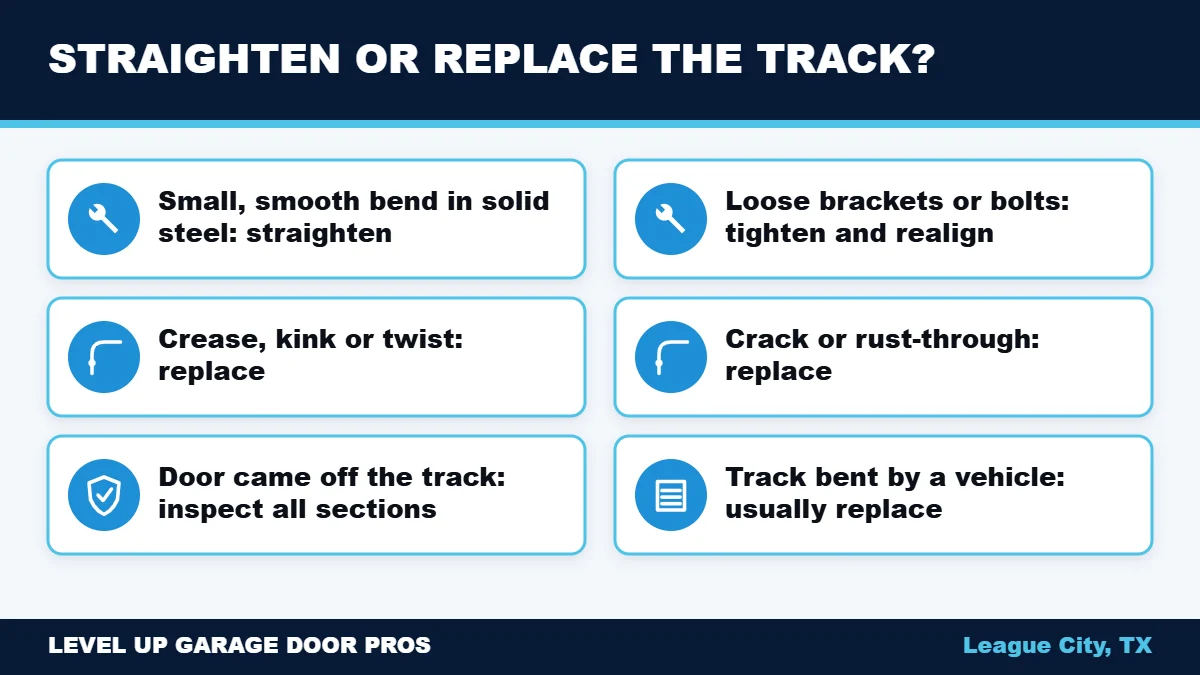
Repair is usually reasonable when:
- The bend is minor and smooth, with no sharp crease.
- The steel is sound, with no cracks, splits, or rust-through.
- The problem is loose brackets or fasteners rather than damaged track.
- Once realigned, the rollers move smoothly through the whole path.
A technician can often straighten a small dent with the right tools, then loosen the brackets, bring the track back to plumb and parallel, and retighten everything. Our earlier guide on how to fix a bent garage door track walks through what that repair involves.
When Does a Garage Door Track Need to Be Replaced?
Steel has a limit. Once a track has been creased, kinked, or bent back and forth, the metal work-hardens and tends to spring back out of line. Replacement is usually the safer choice when:
- The track is creased, kinked, or twisted.
- There is visible cracking or separation in the metal.
- Rust has eaten through the steel rather than just the surface.
- A vehicle hit the door hard enough to bend the track significantly.
- The door came off the track or nearly did.
- Brackets are warped or pulled out of the wall framing.
- The same section has been straightened before and bent again.
Replacement track has to match the door’s height, lift type, track size, and radius, so the technician will measure carefully before ordering. Often only the damaged side or section is replaced, not the entire system.
What Happens During a Track Service Visit?
A track call is rarely just about the track. A typical visit follows a sequence like this:
- Disconnect the opener and check the door’s balance by hand, so a weak spring is not mistaken for a track problem.
- Inspect both tracks from the floor to the back hangers, looking for bends, creases, cracks, and rust.
- Check every roller for wobble, flat spots, or broken bearings, and every hinge for cracks or loose screws.
- Confirm the brackets are tight and still anchored in solid framing.
- Measure the gap between the door and the tracks on both sides to confirm the door is centered.
- Straighten and realign, or measure for replacement track, depending on what the inspection shows.
- Reconnect the opener, adjust the force and travel limits if needed, and run the door through several full cycles.
If a section of track has to be ordered, the technician should leave the door secured and explain whether it is safe to use in the meantime.
How Do Track Repair and Replacement Compare?
| Factor | Track repair | Track replacement |
|---|---|---|
| Best for | Minor bends, loose brackets, misalignment | Creases, cracks, rust-through, impact damage |
| Parts | Usually none, or new fasteners | New track section, often new brackets |
| Time | Often a single visit | May need parts ordered first |
| Long-term reliability | Good if the steel is sound | Restores a straight, strong path |
| Typical cost | Lower | Higher, but less than a new door |
Is It Safe to Use a Door With a Bent Track?
It is not a good idea. A garage door can weigh several hundred pounds, and a misaligned track can let rollers pop out and the door drop or hang at an angle. If the door is off the track, unplug the opener, keep people and vehicles clear, and do not try to force it back by hand. Doors usually come off track because something else failed first, often a broken spring or cable, and those parts store a large amount of energy. Our post on what to do when a garage door is off track covers the immediate steps.
How Can You Keep Tracks in Good Shape?
- Wipe the inside of the tracks clean of dirt and debris every few months.
- Do not grease the inside of the track. Lubricate the rollers and hinges instead.
- Check that the brackets and bolts along the vertical track are tight.
- Replace worn or wobbly rollers before they damage the track.
- Keep the door balanced by having springs inspected regularly.
- Be careful backing in and out, since most bent tracks start with a bumper.
Our guide on how to clean garage door tracks explains the right way to do the first step.
Track Repair and Replacement in League City
At Level Up Garage Door Pros, we inspect the whole system before recommending track work. That includes the rollers, hinges, brackets, springs, and cables, because a bent track is often a symptom of another problem. We straighten and realign track when the steel is sound and replace sections when it is not, for both residential and commercial doors. If your door is grinding, shaking, or sitting crooked, our garage door repair services cover track alignment, section replacement, and the hardware around it. We work in League City, Dickinson, and nearby areas.
Frequently Asked Questions
Can a bent garage door track be fixed?
Often, yes. A small, smooth bend in sound steel can usually be straightened and realigned. Tracks that are creased, kinked, cracked, or rusted through should be replaced.
How do I know if my garage door track needs replacing?
Look for sharp creases or kinks, cracks, rust that has gone through the metal, or a section that keeps bending out of line after being straightened. Damage from a vehicle impact also often calls for replacement.
Should I lubricate the inside of my garage door tracks?
No. Grease inside the track collects dirt and can make rollers slide instead of roll. Clean the tracks and lubricate the rollers and hinges instead.
Why does my garage door keep coming off the track?
Common causes include bent or loose track, worn rollers, a broken spring or cable, and an opener forcing a door that is binding. A technician should inspect the whole system.
Do I need to replace both tracks if one is bent?
Not always. Often only the damaged side or section needs replacement, as long as the new track matches the door’s height, lift type, and size.