
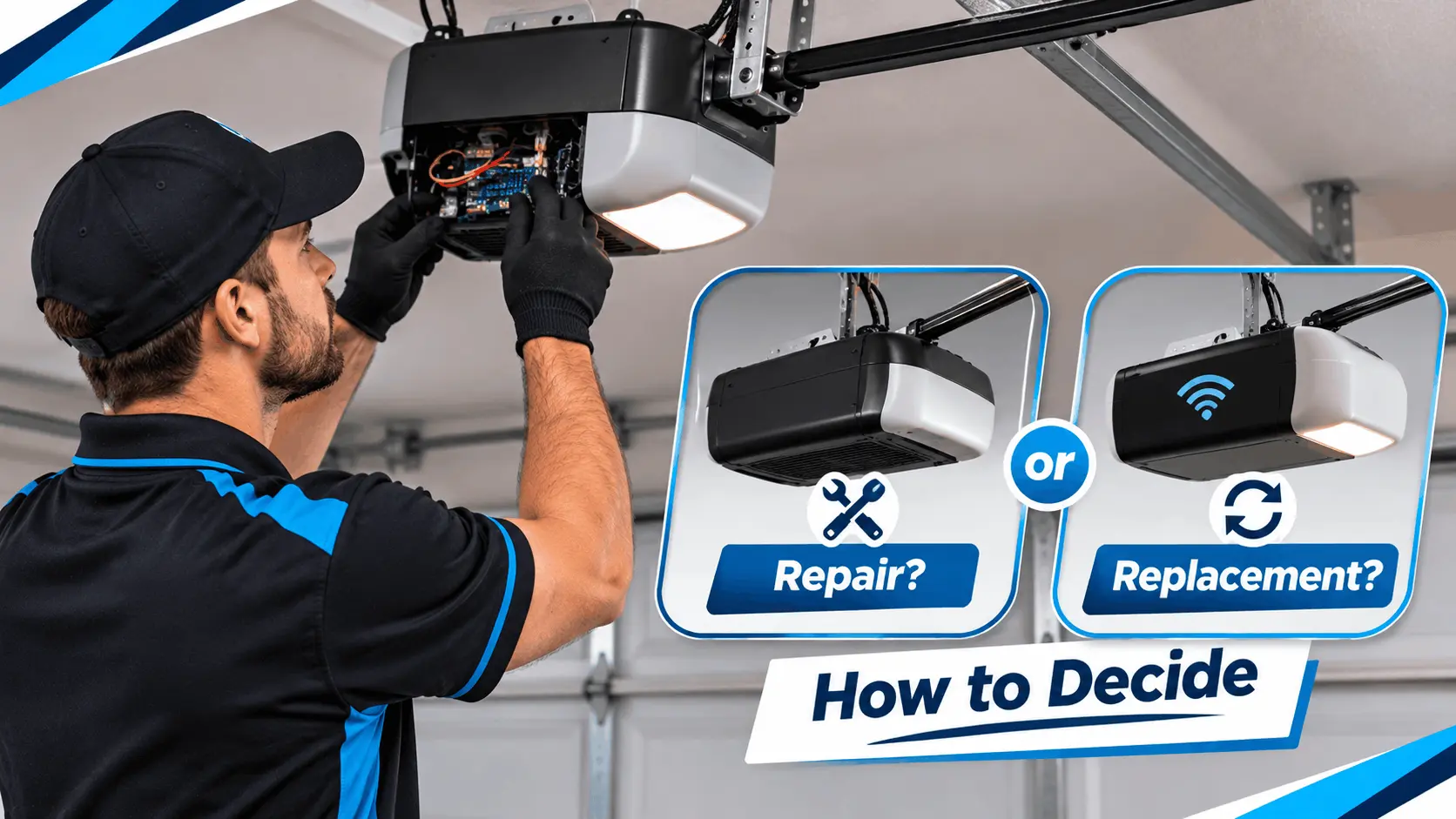

Garage Door Opener Repair or Replacement? How to Decide
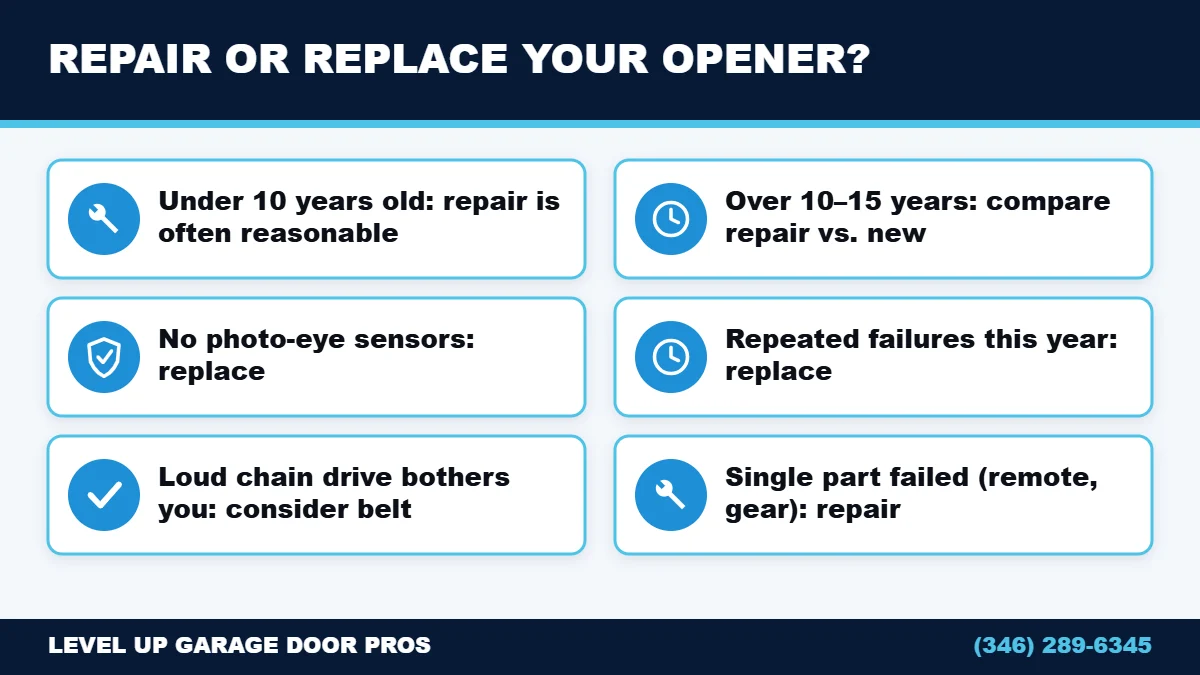
Repair your garage door opener if it is under about 10 years old, the problem is a single part such as a drive gear, sensor, capacitor, or logic board, and the motor otherwise runs well. Replace it if the unit is 10 to 15 years old or more, has needed repeat repairs, lacks working safety sensors, is too loud for the space, or no longer has parts available. In many cases the deciding factor is not the opener at all but the door: a worn spring or binding track can make a healthy opener look like it is failing.
An opener that hums, clicks, or stops halfway is frustrating, and it is easy to assume the whole unit is finished. On service calls, we often find that a ten-dollar part or a simple adjustment gets the door moving again. Other times, the opener is old enough that putting money into it does not make sense. Here is how to tell the difference, and what our opener repair and installation technicians look at before recommending either option.
How Long Should a Garage Door Opener Last?
Most residential openers last somewhere around 10 to 15 years. Usage, maintenance, and especially door balance make a big difference. A door with healthy springs feels light, so the opener only guides it. A door with weak springs forces the motor and gears to do the lifting, which wears them out early. Our article on how long garage door openers last covers what shortens and extends that lifespan.
Which Opener Problems Are Usually Worth Repairing?
- Stripped drive gear or sprocket: Common on chain and belt openers that are several years old. The motor hums but the chain or belt does not move. Gear kits are inexpensive and the repair is routine.
- Safety sensors: Dirty, misaligned, or damaged photo-eyes stop the door from closing and make the light flash. Cleaning, realigning, or replacing the sensors fixes it.
- Remotes and keypads: Weak batteries, lost programming, or a lock mode on the wall control can make the opener seem dead.
- Capacitor or start problems: A motor that hums but will not start may need a new capacitor.
- Logic board: Boards can fail after power surges, which are common during Gulf Coast storms. A replacement board is often worthwhile on a newer opener.
- Travel limits and force settings: If the door stops short or reverses on its own, an adjustment may be all it needs.
If your motor runs but the door does not move, our guide on an opener that hums but the chain does not move explains the usual causes.
When Is Replacement the Smarter Choice?
- The opener is over 10 to 15 years old. Parts get harder to find, and fixing one component often reveals the next weak spot.
- It needs repeated repairs. Two or three service calls in a short period can add up to the price of a new unit.
- It lacks modern safety protection. Openers made before the early 1990s often predate the requirement for photo-eye entrapment protection. If yours has no sensors, replacement is strongly recommended.
- It is too loud. Swapping an old chain drive for a belt drive or wall-mount unit can make a big difference if there is a bedroom above or beside the garage.
- You want features it cannot add. Built-in Wi-Fi, battery backup, and better security codes come standard on many current models.
- Parts are discontinued. If the logic board or rail for your model is no longer available, repair may not be an option.
For warning signs to watch for, see signs your garage door opener is failing.
What Does an Opener Repair Visit Look Like?
A good opener diagnosis takes a few minutes and follows a clear order, so you are not paying for parts you do not need:
- Check power, the outlet, and the wall control, including the lock or vacation setting.
- Test remotes and keypads and confirm they are programmed.
- Disconnect the opener and test the door’s balance by hand.
- Inspect the photo-eyes for alignment, damage, and loose wiring.
- Listen to the motor and look at the drive gear, sprocket, chain or belt, and trolley.
- Review the travel limits and force settings.
- Explain the findings and give a written price for repair, and for replacement if it is close.
If the technician cannot tell you which part failed and why, ask. A clear explanation is part of the service.
How Do Storms and Power Surges Affect Openers?
League City’s weather is hard on electronics. Lightning and power surges during storms are a common reason logic boards and receivers fail, and humidity can corrode connections over time. A few simple steps help:
- Plug the opener into a surge-protected outlet rated for the motor.
- Choose a model with battery backup so you can still use the door during outages.
- Learn where your emergency release cord is and how to re-engage it after the power returns.
- Keep the area around the photo-eyes dry and free of debris.
Commercial operators face the same issues on a larger scale, which is why many facilities keep a backup plan for manual operation during storm season.
How Do Repair and Replacement Compare?
| Factor | Repair | Replacement |
|---|---|---|
| Upfront cost | Lower | Higher |
| Best for | Newer openers with one failed part | Older units, repeat failures, missing sensors |
| Safety features | Same as the current unit | Current sensors and rolling-code security |
| Noise | No change | Option to choose a quieter drive |
| Smart features and battery backup | Only if the unit supports add-ons | Available on many current models |
| Expected life | Depends on remaining components | Full new service life and warranty |
A practical way to use this table: add up what the repair will cost today and what else on the opener is likely to need attention in the next year or two. If that total is getting close to the price of a new, properly sized opener with a fresh warranty, replacement usually comes out ahead. If the opener is fairly new and the failed part is the only issue, repair is the sensible choice. When it is close, ask for written prices on both options so you can compare them side by side instead of deciding on the spot.
Is the Opener Actually the Problem?
Before you replace anything, rule out the door itself. With the door closed, pull the red emergency release cord, then lift the door by hand to about waist height and let go. A balanced door stays roughly in place. If it feels very heavy, slams down, or shoots up, the springs need attention, and a new opener will not fix that. Other door problems that mimic opener failure include:
- A bent track or worn rollers that make the door bind, so the opener reverses as if it hit something.
- A broken cable that leaves the door hanging crooked.
- A frozen or rusted bearing that adds resistance.
If the door is the issue, fixing it first protects the opener you have, or the new one you buy.
What Should You Consider When Choosing a New Opener?
- Drive type: Chain is durable and economical, belt is quieter, and wall-mount units free up ceiling space.
- Door size and weight: Heavier or taller doors may need more lifting power or a longer rail.
- Remote compatibility: Staying with the same brand family can keep your existing remotes and vehicle buttons working.
- Battery backup: Useful in League City, where storms and outages are common.
- Smart features: Check current app and device compatibility for the exact model.
If you are comparing brands, our guide to LiftMaster vs. Chamberlain vs. Genie explains the real differences, and our breakdown of opener installation cost covers what affects the final price.
Garage Door Opener Repair and Replacement in League City
At Level Up Garage Door Pros, we test both the opener and the door before recommending anything. If a repair makes sense, we explain the part and the cost. If replacement is the better value, we walk you through drive types, brands, and features that fit your garage. We work on residential and commercial openers across League City, Santa Fe, and nearby communities.
Frequently Asked Questions
How do I know if my garage door opener needs to be replaced?
Consider replacement if the opener is 10 to 15 years old or more, needs repeated repairs, lacks working safety sensors, or no longer has parts available. A newer opener with one failed part is usually worth repairing.
Can a broken spring make my opener stop working?
Yes. With a broken spring, the opener may hum, strain, or lift the door a few inches and stop. Running it this way can strip gears or damage the motor.
Is it worth repairing a 15-year-old garage door opener?
It can be if the repair is minor and parts are available, but at that age it is worth comparing the cost against a new unit with current safety and security features.
Why does my opener hum but the door does not move?
A stripped drive gear, a failed capacitor, or a door that is too heavy because of a weak spring are common causes.
What is the quietest type of garage door opener?
Belt drive and wall-mount jackshaft openers are generally the quietest. Chain drive openers are usually the loudest.